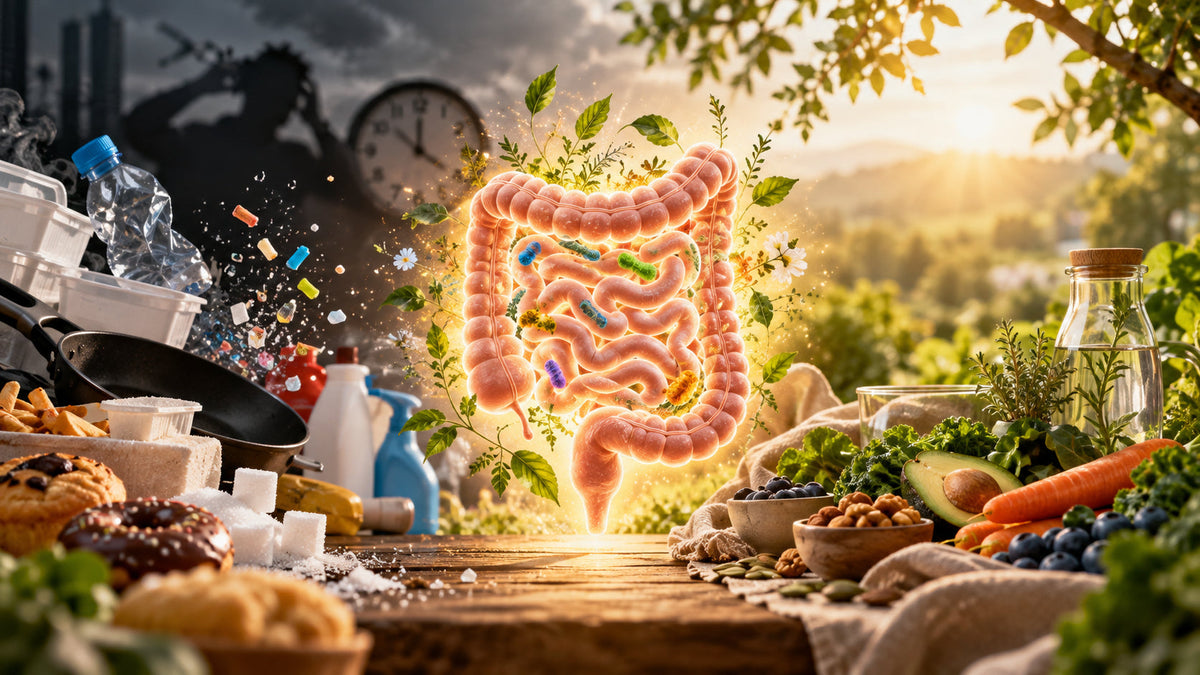
Our gut is exposed to numerous other stressors every day: PFAS, microplastics, plasticizers, sugar, oxalates, surfactants, additives, medications, and chronic stress can all affect the gut microbiome and the intestinal barrier.
That is why we look not only at what we eat, but also at the stressors our gut is exposed to in daily life.
PFAS – Long-lasting chemicals in our environment
PFAS stands for per- and polyfluoroalkyl substances. This is a large group of several thousand artificially produced chemicals. They are characterized by particularly stable carbon-fluorine bonds and are therefore water, grease, and dirt-repellent.
These exact properties make PFAS technically interesting – and at the same time an environmental problem: many PFAS break down very slowly and can remain in the environment for a long time. This is why they are also referred to as "forever chemicals".
We encounter PFAS, among other things, in non-stick coatings, certain food packaging, water and dirt-repellent clothing, waterproofing agents, and various technical products.
Particularly well-known is PTFE, which is known under the brand name Teflon and is used for non-stick coatings. Chemically, PTFE belongs to the PFAS group. When used as intended, the German Federal Institute for Risk Assessment does not currently see a health risk for consumers. However, extreme overheating of empty PTFE pans should be avoided.
PFAS can also be ingested via food contact materials. They have been used, for example, in certain grease and water-repellent paper and cardboard packaging.
Our assessment: Due to their extreme longevity, PFAS are among the substances whose unnecessary ingestion and use we would like to reduce. For us, this is not about completely excluding every PFAS source in everyday life, but about switching to alternatives where we can easily choose them.
Our approach: We prefer unpackaged food whenever possible, as well as glass and stainless steel for storage. For pans, we prefer to use stainless steel, cast iron, or enamel and reduce unnecessary non-stick and fluorinated coatings. Regarding food packaging, we also ensure we use the simplest and uncoated materials possible.
Teflon pans, plastic tableware, and kitchen utensils
It is not just the food itself that can come into contact with unwanted substances. Pans, cans, bowls, cutting boards, wooden spoons, and other kitchen helpers can also transfer substances to our food.
Heat, fat, acid, mechanical abrasion, and long contact times are particularly relevant in this regard. Therefore, plastic should especially not be heated unnecessarily or used for the long-term storage of fatty foods. With damaged or heavily scratched coatings, the question also arises as to whether it makes sense to replace them.
Our assessment: We think it makes sense to have as little plastic and coated material in direct contact with our food as possible. Especially in the kitchen, we can very easily avoid many of these contacts.
Our approach: We prefer glass, stainless steel, cast iron, and enamel for preparation and storage. For kitchen utensils, we prefer to reach for wood, stainless steel, or other long-lasting materials. We use plastic where it makes sense – but preferably not for heating and not for long-term storage of warm or fatty foods.
Microplastics: a stressor that reaches the gut
Microplastics and nanoplastics enter our body through food, water, and the environment. Research shows possible effects on the gut microbiome, the mucous layer, and the intestinal barrier.
Particularly relevant for us is the fact that plastic frequently comes into contact with food in everyday life and is sometimes heated.
Our assessment: We should avoid unnecessary plastic contact with food.
Our approach: Use glass or stainless steel for storage, do not heat food in plastic, and reduce single-use plastic.
Plasticizers: Plastic can be chemically more than just plastic
Phthalates and other plasticizers are used in numerous plastic products. They can be absorbed through food and packaging.
Research shows links between them and changes in the gut microbiome and the intestinal barrier.
Our assessment: Especially because food is often in contact with packaging for long periods, avoiding unnecessary exposure makes sense.
Our approach: Buy food as fresh as possible, reduce plastic contact, and pay attention to suitable materials, especially with fatty foods and heat.
Sugar: Food for an imbalanced microbiome
Consistently high sugar consumption can change the composition of the gut microbiome. At the same time, a high-sugar diet can be associated with changes in the intestinal barrier and microbial metabolic products.
We see the problem primarily in the regular and high consumption of added sugar – especially in combination with highly processed foods.
Our assessment: A gut-friendly diet should contain as little added sugar as possible and as few highly processed products as possible.
Our approach: Water instead of sugary drinks, natural foods instead of sweets and convenience products, and a diet with sufficient high-quality fiber sources, provided they are individually tolerated.
Oxalates: When plant-based foods can become a problem
Oxalates occur naturally in numerous plants, including spinach, chard, and certain nuts.
They are not fundamentally problematic. The deciding factors are the amount, individual metabolic situation, and absorption in the gut. Oxalate is particularly relevant in the context of calcium oxalate kidney stones.
The gut microbiome can also play a role in breaking down oxalate.
Our assessment: We should not generally view plant-based foods as unproblematic. Individual tolerance and the total amount are the deciding factors.
Our approach: In cases of sensitivity, reduce oxalate-rich foods and use preparation methods like boiling, which can partially reduce the oxalate content.
Dish soap and surfactants: What remains on our dishes?
Surfactants dissolve grease and dirt and are therefore central components of dishwashing detergents and rinse aids.
An experimental study showed that certain components of rinse aids can impair the intestinal barrier in cell, organoid, and gut-on-a-chip models.
This does not automatically mean that normal dishwashing makes humans sick. However, it does show that cleaning agent residues can be a relevant factor for the intestinal barrier.
Our assessment: Cleaning agents should be dosed so that as little as possible remains on the dishes.
Our approach: economical dosage, thorough rinsing, and, for sensitive individuals, cleaning products that leave as few residues as possible.
Emulsifiers and additives: What is industrially practical does not have to be neutral for the gut
Many highly processed foods contain emulsifiers and other additives. They ensure creaminess, stability, and a consistent texture.
For some emulsifiers, there is experimental evidence of changes to the microbiome, the intestinal mucosa, and the intestinal barrier.
Our assessment: The more processed a food is, the more additives it often contains. We therefore see a clear advantage in a diet that is as unprocessed as possible.
Our approach: Favor foods with a short list of ingredients and reduce highly processed products.
Stress: The gut reacts to our nervous system
The gut and the brain are in constant communication via the gut-brain axis.
Chronic stress can influence gut movement, the intestinal barrier, immune responses, and the microbiome. At the same time, changes in the gut can in turn affect the nervous system.
Our assessment: Chronic stress is not a secondary issue regarding gut health. It is one of the factors that we must consider just as much as our diet.
Our approach: sufficient sleep, regular exercise, conscious relaxation phases, and as little permanent overload as possible.
Gellan and other thickeners
Thickening and gelling agents such as gellan, xanthan, carrageenan, guar gum, or locust bean gum can also be relevant for gut health. They are used to give foods a certain consistency and to stabilize products. Some of these substances can interact with the microbiome and the intestinal mucosa in the gut. The scientific data situation varies greatly depending on the substance and cannot be applied across the board to all thickeners.
Our assessment: The more highly processed foods we eat, the more frequently we ingest various technological additives at the same time. For us, the problem is not the individual additive, but the sum and the continuous intake of many such substances.
Our approach: We prefer foods with few, natural ingredients and reduce products that contain a long list of thickeners, stabilizers, emulsifiers, and other additives. Especially with a sensitive gut, it can make sense to specifically reduce individual additives and observe one's individual reaction.
What happens when the intestinal barrier is impaired?
The intestinal barrier has a central protective function. It helps determine which substances from the gut contents enter our body.
If this barrier is impaired, the permeability of the intestinal mucosa, immune responses, and inflammatory processes can change.
In parallel, the gut microbiome can change.
This is precisely why we do not view gut health in isolation.
A disturbed gut environment can extend far beyond digestion.
The microbiome is connected to the immune system, metabolism, and the nervous system, among other things. Therefore, the stability of the entire gut ecosystem is crucial to us.

Our approach to a healthy gut environment
We therefore do not just focus on individual foods.
Our approach consists of several simple basic principles:
1. Reduce/avoid lectins.
2. Reduce highly processed foods and added sugar.
3. Minimize plastic contact with food.
4. Reduce PFAS and unnecessary chemical stressors in daily life.
5. Avoid plasticizer sources where it is easily possible.
6. Pay attention to dish soap and surfactant residues.
7. Reduce additives and emulsifiers through a diet that is as unprocessed as possible.
8. Take oxalate-rich foods into account if there is individual sensitivity.
9. Reduce chronic stress and lack of sleep.
By doing this, we change more than just individual meals. We create an environment in which the intestinal barrier and microbiome can better fulfill their tasks.
The potential of a healthy gut
A healthy gut is far more than just functioning digestion.
The gut microbiome produces important metabolic products, influences the immune system, and is in close exchange with our metabolism and our nervous system.
The intestinal barrier protects our body from unwanted substances while simultaneously allowing for the absorption of nutrients.
This is why we view gut health as a foundation for the entire organism.
If we want to keep the gut healthy or bring it back into balance, in our view, it is not enough to look at just one food or one substance.
We must consider the entire stress load on the gut.
Lectins are one part of it. PFAS, microplastics, plasticizers, sugar, oxalates, surfactants, additives, and stress are others.
This is exactly where we start: reducing stress, protecting the intestinal barrier, and giving the gut the conditions under which a healthy microbiome can function.
*Our note on xanthan: Xanthan holds a special position for us. We use xanthan specifically in some of our products because, due to its properties, we consider it to be prebiotic or a substrate for certain gut bacteria. For us, this distinguishes it from many other technological additives. The decisive factor for us is not to avoid additives on principle, but to look at their function and their effect on the gut. That is why xanthan is deliberately our choice when we need a suitable binding or consistency for a product.